
Trace Former Queens County Property Owners Backward
You find former owners by walking the deed chain backward. A recent-sales list will not do the job. Begin with the newest verified deed. Read its grantor. Then locate the deed through which that same grantor acquired the parcel, and keep stepping back.
| Transfer date | Grantor to grantee | Deed type | Citation |
|---|---|---|---|
| Newest | As shown in image | Exact instrument class | CRFN / document ID |
| Prior | Earlier parties | Exact instrument class | CRFN or reel/page |
| Historic | Transcribed parties | Deed-book entry | Book and page |
Every row in the chain must carry the same BBL, unit, or legal-description link. A shared name alone proves nothing about continuity.
Walk the Queens Grantor-Grantee Chain
In ACRIS, search Queens borough 4 with the block and lot. Open the current acquisition deed first. Its grantor becomes your next search target. Look for that party as a grantee in an earlier period, then repeat the cycle. Include correction deeds, estate deeds, and referee deeds instead of filtering for conventional sales only. Note document dates and recording dates separately. Preserve the CRFN or document ID and the image status. A later reader can then reproduce each step.
Use ACRIS Filters Without Hiding Prior Owners
Date and document-class filters shrink large ACRIS result sets. They can also hide a relevant conveyance, so use them with care. Party searches demand exact attention to business names, spelling variants, and role. A name beside the parcel can look important. A mortgagee, though, is not a former owner.
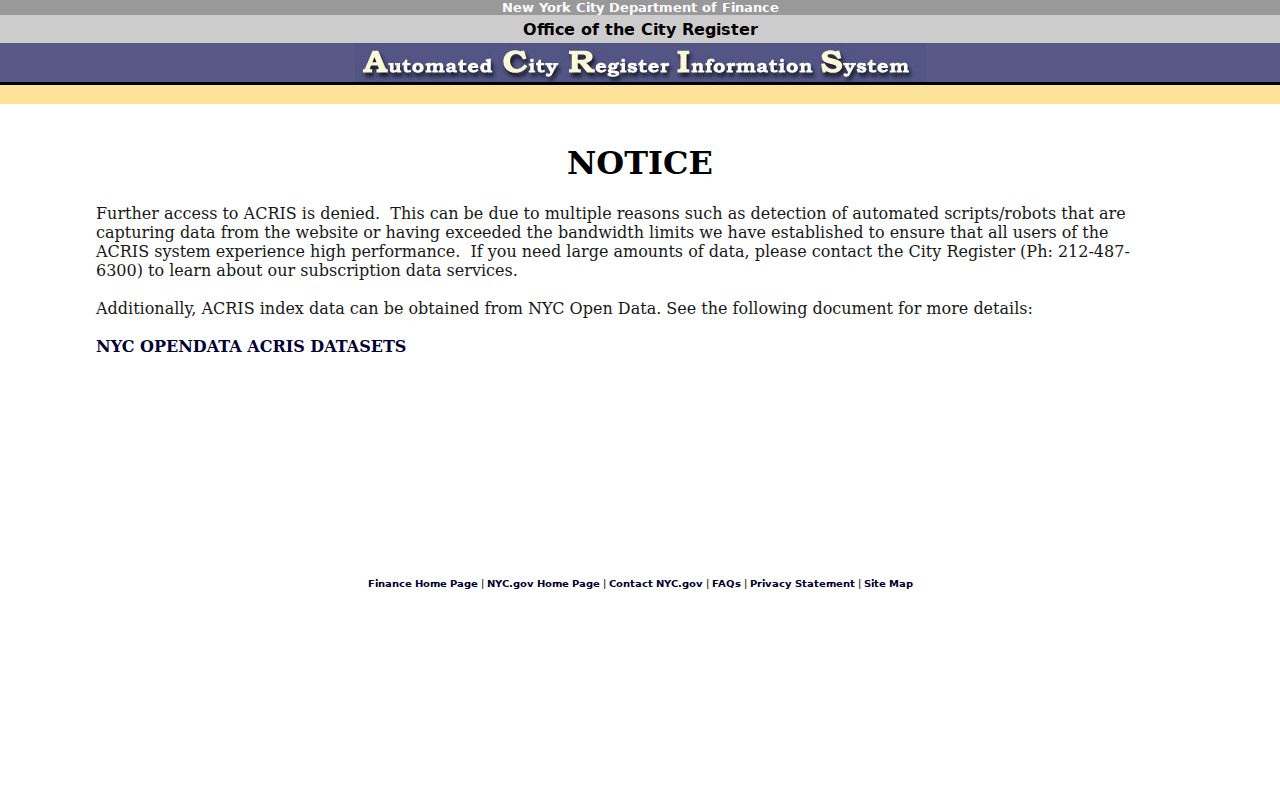
The ACRIS parcel-search guidance shows the Queens BBL, unit, date and class controls.
Extend the Queens Chain Before 1966
Queens land records before 1966 live in the City Register Land Record Research Library. Work backward from the last online-linked instrument. Bring its prior references, party names, legal description, modern BBL, and historic street clues with you.
Online cutoff. No ACRIS result before the coverage boundary does not mean there was no earlier owner.
Reel, filing year, and page matter for some legacy records, chiefly before January 2, 2003. Retain those values whenever ACRIS supplies them.
Bridge Old Queens Streets and Towns
Queens formed in 1683. Western Queens joined New York City in 1898, and Nassau split off in 1899. Older deeds may name former towns, villages, or streets that no longer match modern usage. Long Island City once carried an incorporated meaning quite different from today's neighborhood label. Old Town Records and NYPL atlases can bridge that shifting geography. Directories and Queens Public Library maps help too. Cite the sheet, volume, and year, then return to deed evidence for proof.
Use Directories as Context, Not Ownership
A historic directory can place a person or business at an address. It can also list an occupation. It cannot prove the person owned the parcel. It may not even show the address was a private home. Verify the scan and the abbreviation key. When the street was renumbered, compare cross streets, atlas lots, and deed descriptions. Do not join two people by name alone.
Account for Queens Probate Transfers
A death can interrupt a clean grantor-grantee sequence. Search the decedent, the estate, any fiduciary deed, and the relevant Surrogate's Court proceeding together. Letters or a decree may explain who held authority. The later ACRIS instrument ties the estate to the parcel. Never list a beneficiary as an owner unless the record actually conveys or vests the property interest.
Account for Queens Foreclosure Transfers
A lis pendens or judgment alone does not prove title changed hands. Follow the case through judgment, auction, and referee deed. Along the way, check for dismissal, settlement, or release.
The Queens foreclosure calendar provides scheduled auction and case information.
Define the Proven Depth of the Chain
State the oldest verified transfer, the source coverage, any missing image, and the search date. Never imply an unbroken chain when a link rests on a map, directory, or index-only result. Say plainly where inference begins.
Historical limit. Former-owner research is not a title opinion; unresolved gaps belong with the City Register, archives and a title professional.
Track Queens Lot Changes Through Time
A chain can look broken for a simple reason. The modern lot did not always exist in its present form. Review tax-map history, deed schedules, and subdivision references for predecessor lots. Carry old and new BBLs in separate columns, along with the instrument connecting them. Same-address continuity proves nothing. Condominium creation can swap a base-lot history for unit lots. A merger combines former parcels. Define whether your chain concerns the land, a unit, common elements, or the building.
Present Former Owners Without Filling Gaps
A deed chain should list only parties named in a recorded deed or in a clearly labeled index entry. The two evidence levels should be distinguished from each other. Uncertain spellings, missing images, and legal descriptions that do not match belong in a notes column. When a chain jumps from an online filing to a library-era reference, state the gap plainly. Do not guess at an intermediate transfer.
Any honest timeline ends with a coverage statement. It should name the first and last dates covered, the repositories searched, the material that was unavailable, and the date of the search. In Queens, that statement matters most. The pre-1966 library boundary and the county's older town geography can make a short online chain look complete. It is not.